
MacBook Pro M4 M5 Common Problems in Dubai? Here's What's Wrong and How to Fix It
The M4 and M5 MacBook Pros are the fastest laptops Apple has ever made, but they are not immune to faults. In Dubai's 45°C summer ambient, certain problems appear more often than Apple's specs suggest. Most have a fix you can try in 10 minutes. Some need a technician. Diagnosis is always free, message us on WhatsApp for a repair quote on your model.
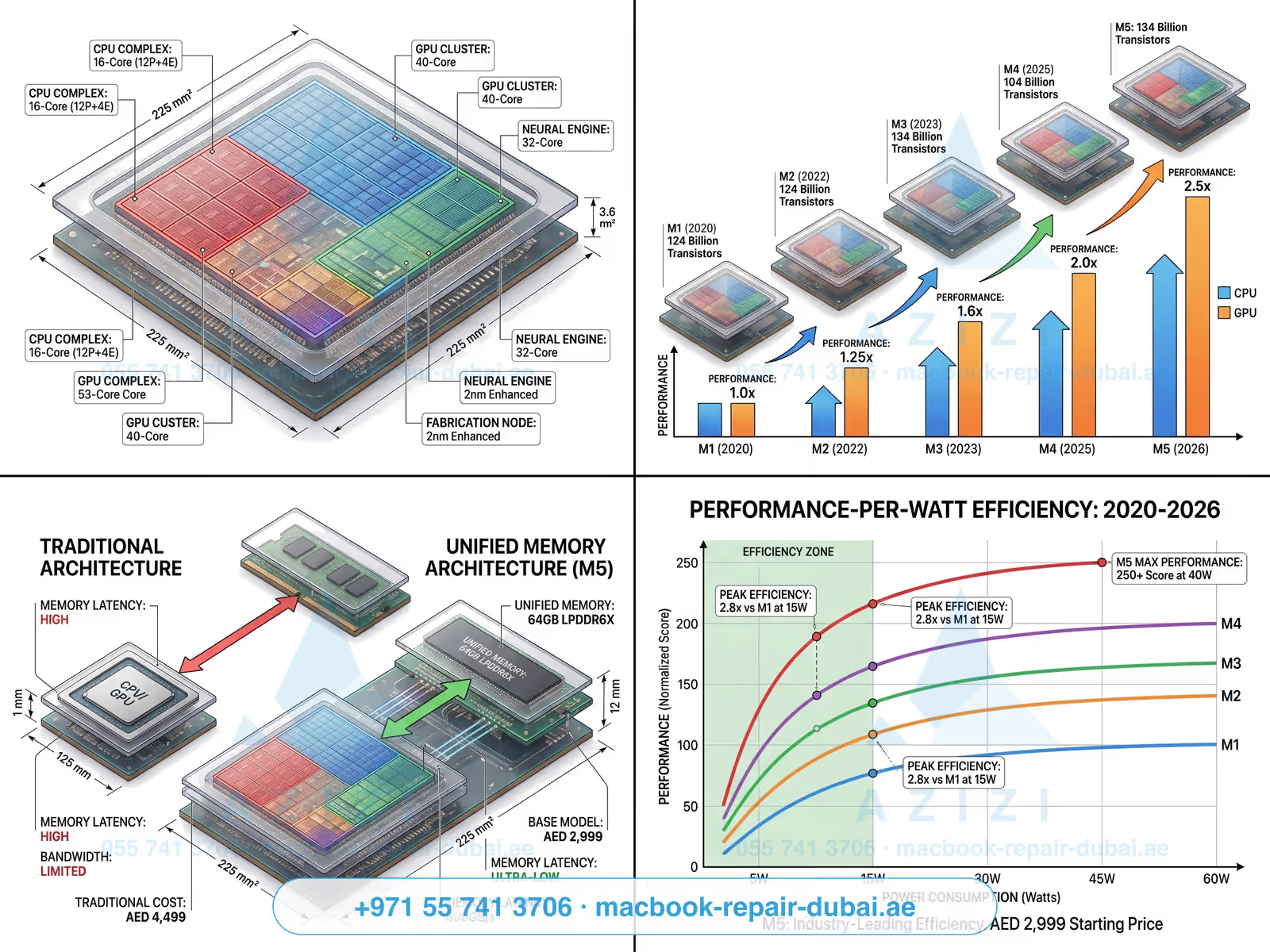
M4 and M5 MacBook Pros arrived with Apple Silicon chips rated for extraordinary performance and efficiency. In normal conditions, they deliver on that promise. In Dubai, where ambient temperatures hit 45°C outdoors and laptop bags bake in parked cars, certain weaknesses surface that users in cooler climates rarely see.
Below are the ten most common problems we diagnose on M4 and M5 MacBook Pros in our Dubai workshop, with what causes each one and what you can do about it.
What Display Problems Affect MacBook Pro M4 and M5?
Display faults are the most reported hardware complaint on current MacBook Pro models. The symptoms fall into three categories:
- Flickering at low brightness: usually a firmware or ProMotion timing issue, try a macOS update first
- Black screen on wake: the display goes dark after sleep and only recovers after closing and reopening the lid, often a display controller bug patched in subsequent macOS point releases
- Stage Light effect (Flexgate): a bright strip at the bottom of the screen with darkness above it, caused by the flex cable bending at the hinge, more common on 14-inch models that are opened and closed many times per day
Check for updates first: Apple menu, System Settings, General, Software Update. If the flickering started with a specific macOS version, roll back using macOS Recovery or wait for the next patch. If the Stage Light effect is present, the flex cable needs physical replacement, not software. Message us on WhatsApp for a repair quote on your model.
One Dubai-specific pattern: leaving the MacBook on a desk in direct sunlight through a floor-to-ceiling window causes the display to auto-dim to 0 nits as a heat protection measure. This looks like a black screen fault but recovers in a cool environment. Move the laptop out of direct sun first before concluding the display is faulty.
Why Does Wi-Fi Keep Dropping on MacBook Pro M4?
Wi-Fi dropping on M4 and M5 MacBook Pros is almost always a Bluetooth coexistence problem, not a failing Wi-Fi chip. Apple's Wi-Fi 6E and Bluetooth 5.3 share antenna real estate, and when both are active and busy, the firmware has to arbitrate between them. The result is momentary Wi-Fi drops every few minutes.
Steps to diagnose and fix:
- Turn off Bluetooth temporarily: if Wi-Fi stabilises immediately, this confirms coexistence as the cause
- Switch to 5GHz or 6GHz band: 2.4GHz overlaps more heavily with Bluetooth frequencies
- Delete Wi-Fi preferences: remove
/Library/Preferences/SystemConfiguration/com.apple.wifi.plistand reboot - Check for macOS update: Apple released coexistence firmware patches in macOS Sequoia 15.3 and 15.4
- AirPort Base Station vs mesh router: some third-party mesh systems have 2.4GHz beacons that interfere heavily with M-chip Wi-Fi
If Wi-Fi drops even with Bluetooth off, and the problem started recently without a macOS update, the Wi-Fi/Bluetooth module may have a solder joint failure. We see this more often on units that have been dropped or exposed to humidity. Diagnosis is free.
Is 8GB Enough? Memory Pressure on Base M4 Models
The base M4 MacBook Pro ships with 8GB of unified memory. For light tasks this is adequate. For anyone running Chrome with 10+ tabs, Slack, Zoom, Figma, or Xcode, memory pressure becomes a real daily problem.
How to check your memory situation:
- Open Activity Monitor (Spotlight, type "Activity Monitor")
- Click the Memory tab
- Look at the Memory Pressure graph at the bottom
- Check Swap Used in the bottom row
A green memory pressure graph is healthy. Yellow means the system is managing actively. Red means the Mac is swapping aggressively to its SSD, which both slows the machine and adds write cycles to the storage.
If Swap Used is consistently above 2GB during your normal workload, you have outgrown 8GB. The M4 MacBook Pro cannot have its memory upgraded after purchase, the RAM is on the SoC. The practical fix is to close apps aggressively, use Safari instead of Chrome (lower memory footprint), or accept that the next MacBook will need 16GB as a base configuration.
Does Dubai Heat Throttle MacBook Pro M4 and M5?
Yes, but in a different way than Intel MacBook Pros did. Apple Silicon chips are designed to throttle earlier on paper but recover faster in practice. Here is what actually happens:
- M4 throttle threshold: CPU begins reducing clock speed when the chip reaches approximately 95°C internally, which in a 45°C Dubai room can happen during sustained renders or video exports
- M5 throttle threshold: similar, but the M5 Pro and M5 Max have a larger thermal mass and two fan arrays in the 16-inch model, they sustain full speed longer before throttling
- Recovery time: Apple Silicon recovers from throttle in 30-60 seconds once the load drops; Intel MacBook Pros often stayed throttled for several minutes
- Fan behaviour: M4 MacBook Pro fans are nearly silent during light use, they ramp hard during heavy loads, if the fans are loud constantly even at idle in Dubai, the thermal paste or airflow path needs attention
The biggest Dubai-specific issue is not throttling during use but the laptop sitting in a closed bag in a car. Ambient temperatures of 60-80°C in a parked car cause the M4/M5 chip to reach its safe storage limit. The Mac will refuse to boot until it cools down. If it was exposed to extreme heat and now behaves erratically, bring it in for a thermal inspection.
To check if throttling is happening during use: install Stats (free, from the App Store) and watch the CPU frequency bar. If it drops below 50% of rated clock speed during heavy tasks, throttling is active.
What Are USB-C Port Problems on M4 MacBook Pro?
The M4 MacBook Pro 14-inch has three Thunderbolt 4 / USB 4 ports. All three handle charging, data, and video output. Because they do everything, they get cycled daily, and over 12-18 months of heavy use, problems emerge:
- Loose fit: the cable no longer seats firmly, it wiggles and charging drops in and out
- Charging inconsistency: the battery indicator shows "not charging" even with the original 96W adapter plugged in, but works fine in a different port
- Data drops: external SSDs disconnect mid-transfer, causing data corruption risk
- No video output: a specific port stops driving an external monitor while the others work fine
The first check is always to try a different cable and a different port. If a port- specific problem is confirmed, bring it in. USB-C port repair on M4 MacBook Pro is a board-level job because the ports are soldered directly to the logic board. The exact cost depends on whether it is socket replacement or trace repair, message us on WhatsApp for a quote after your free diagnosis.
Why Is My MacBook Pro M4 Crashing? Kernel Panics Explained
A kernel panic looks like a sudden black screen, then a grey "Your Mac restarted because of a problem" message at next boot. On M4 and M5 MacBook Pros, kernel panics have three common causes:
- Third-party kernel extensions (kexts): VPN software, antivirus tools, or old printer drivers that have not been updated for Apple Silicon can crash the kernel
- RAM hardware fault: rare but real, the unified memory on the SoC develops a bad cell, causes random crashes under memory pressure
- SSD failure: storage errors cascade into kernel panics, especially if the Mac has been exposed to heat or has very high SSD write cycles
To read your kernel panic logs:
- Open Console app (Spotlight, "Console")
- Select Crash Reports in the left sidebar
- Look for files with "kernel" in the name, sorted by most recent
- The "Backtrace" section names the process that triggered the panic
If the panic log names a third-party process, uninstall that app and test for 48 hours. If the log shows only Apple system processes, the hardware needs testing. Bring it in for a free diagnostic.
M4 Pro vs M4 Max vs M5: Which Has More Problems?
Based on what we see in the workshop, the failure rates differ by configuration:
| Chip | Most common issue | Why |
|---|---|---|
| M4 base (8GB) | Memory pressure, swap-induced SSD wear | 8GB is thin for modern workloads, SSD fills in as virtual RAM |
| M4 Pro (24GB) | Wi-Fi coexistence, display flex cable | 14-inch used as desktop replacement, hinge cycles high |
| M4 Max (48GB) | Thermal throttle under sustained GPU load | GPU workloads on 40-core GPU generate significant heat |
| M5 Pro / Max | Early firmware bugs, USB-C port wear | Newest chip, software still maturing, heavy cable use |
The M4 Max in the 16-inch chassis handles heat best because of its larger fan array. The M4 base in the 14-inch chassis with 8GB is the configuration we see most often for performance-related complaints.
How Do I Reset NVRAM on M4 or M5 MacBook? (No SMC Reset)
On Apple Silicon MacBook Pros (M1 through M5), there is no SMC reset. The System Management Controller function is handled by the chip itself and resets automatically on a full power cycle. What you can reset manually is NVRAM:
NVRAM reset on Apple Silicon MacBook Pro:
- Shut down completely (Apple menu, Shut Down, wait for screen to go dark)
- Press and hold the power button for 10 seconds
- Release when you see the startup options screen
- Select your startup disk and boot normally
Alternatively, from the command line: open Terminal and run sudo nvram -c followed by sudo shutdown -r now. This clears stored display settings, startup disk preference, and Wi-Fi region settings.
The equivalent of an SMC reset for Apple Silicon is a full 30-second shutdown (not restart) followed by a cold boot. This resets the power management state that the chip manages internally.
NVRAM reset fixes: display resolution stuck after external monitor disconnect, Wi-Fi region settings causing band selection issues, startup disk not booting, and some kernel panic loops.
How Much Do M4 and M5 MacBook Pro Repairs Cost in Dubai?
Here are the most common M4 and M5 MacBook Pro repairs we handle. Message us on WhatsApp for today's exact price on your model and fault:
| Repair | Our price | Turnaround | Notes |
|---|---|---|---|
| Diagnosis (all faults) | Free | Same day | We tell you what's wrong before any work starts |
| USB-C port repair (M4/M5) | Price on request | Same day | Board-level socket or trace repair |
| Display cable repair (Flexgate) | Price on request | Same day | Stage Light fix, 14-inch and 16-inch |
| Logic board repair (M4) | Price on request | 2-4 days | Component-level, not full board swap |
| Logic board repair (M5) | Price on request | 2-4 days | Component-level, price varies by fault |
Logic board quotes depend on the specific fault: a failed Wi-Fi chip costs less to replace than a short on the power rail. We quote accurately after diagnosis, before any work starts. MacBook Pro repair Dubai →
When Should I Bring My MacBook Pro M4 to a Dubai Repair Shop?
Most software faults on M4 and M5 MacBook Pros resolve with three steps: macOS update, NVRAM reset, and removing any third-party kernel extensions. If those steps do not fix the problem, the fault is hardware.
Bring it in immediately if you see any of these:
- Kernel panics more than once per week: software causes one-off panics, hardware causes recurring ones
- Stage Light display effect: the flex cable will not self-repair, it progressively worsens
- USB-C port wobbles or drops connection: a loose port can arc and damage the logic board if left
- Fan runs constantly at idle: in Dubai heat this can mean a failing temperature sensor sending false readings
- Mac exposed to heat above 70°C (left in parked car): lithium cells and board components have permanent damage thresholds
We run a free diagnosis on all M4 and M5 MacBook Pros. Drop-off before 11am typically means same-day turnaround for most repairs. Book a free diagnosis →
Frequently asked questions
- In Dubai, 'normal room temperature' indoors with AC off can still be 28-32°C. The M4 chip starts throttling when internal temps hit 95°C, which is reached faster in a warm room. Check Activity Monitor for processes using high CPU at idle. Spotlight indexing after a macOS update or Photos recognition can spike temps for 24-48 hours after setup.
- Sustained use above 95°C internal chip temperature can cause long-term electromigration in the chip, but this takes many hours at sustained full load. The more practical risk is the battery: lithium cells stored above 45°C degrade permanently. A MacBook left in a parked car in July can lose 10-20% battery capacity in a single afternoon.
- Under normal Dubai office use, M4 MacBook Pro units are reliable for 4-6 years before hardware faults become likely. The most common early failure is USB-C port wear (2-3 years with heavy docking), followed by battery degradation (3-4 years). Logic board faults are rare without physical damage or liquid exposure.
- Yes, if the kernel panics are caused by corrupted system files or bad kernel extensions. A clean reinstall via macOS Recovery removes all third-party software and resets the system. If panics continue on a clean install with no third-party apps, the fault is hardware and needs diagnosis. Reinstall first, then bring it in if it persists.
- Board-level component repair takes 2-4 days in most cases. We identify the failed component, source the part (usually same-day for common chips), and reball or replace it. Unlike Apple Store which swaps the entire logic board, we repair at component level, which keeps the cost 60-70% lower.
- If the flicker is mild and software-related, continued use is safe. If the Stage Light effect is present (bright band at the bottom, dark above), the flex cable is partially failing. Continued hinge opening and closing will worsen the tear until the display goes completely black. Get it repaired before that happens.
Related on MacBook Repair Dubai
About the author
Memona is a senior macbook battery technician at MacBook Repair Dubai, Dubai's longest-running Apple-only repair workshop (since 2004). Personally signs the QC checklist on every job leaving the bench.