
iMac Running Slow in Dubai? 8 Fixes to Try Before Upgrading
An iMac running slow in Dubai is usually a near-full startup SSD, a RAM shortage with heavy swap usage, or a macOS corruption, and an SSD or RAM upgrade fixes most Intel iMac performance issues same day. Message us on WhatsApp for today's exact price on your model.
Why is my iMac running slow?
Most iMac performance complaints fall into five categories, and identifying the right one before spending money saves you from an unnecessary upgrade. The fastest way to diagnose is to open Activity Monitor (Applications > Utilities) and check three tabs: CPU, Memory, and Disk. A yellow or red memory pressure graph is the clearest single sign that your machine is swap-limited, not CPU-limited.
Here are the five most common root causes we see at our Dubai workshop, roughly in order of how often they appear:
- SSD at over 90% capacity: macOS uses the startup drive as a swap file and virtual memory. Once free space drops below 10-15%, read/write speed collapses and the entire OS slows to a crawl.
- Insufficient RAM with heavy swap usage: Intel iMacs ship with as little as 8 GB of RAM. Running modern browsers, Office, and Creative Cloud simultaneously forces macOS to swap RAM contents to the SSD, adding hundreds of milliseconds of latency to every app switch.
- Corrupted macOS installation: Interrupted updates, forced shutdowns during updates, or filesystem errors can corrupt system files. Symptoms include long boot times, spinning beachballs, and app crashes rather than just general sluggishness.
- Malware or runaway background processes: Adware and cryptomining malware are common on Intel Macs. They peg one or more CPU cores continuously. Activity Monitor > CPU, sorted by % CPU, will show the offending process.
- Dried thermal paste on Intel models (CPU throttling): Intel iMac CPUs use thermal paste between the CPU die and heatsink. After 4-7 years in Dubai's climate, the paste dries and cracks, thermal resistance rises, and the CPU throttles itself to prevent overheating. This appears as extreme slowness under any sustained load.
M-series iMacs (M1, M3, M4) rarely suffer from thermal paste issues due to their integrated chip design, but they can still hit SSD and software-related slowdowns. The diagnostic steps below apply to both generations.
Step 1: Is the startup SSD full?
Open the Apple menu, go to System Settings (or System Preferences on macOS Ventura and earlier), then click General > Storage. The bar at the top shows how much space is used and what category is using it. If the total bar is 85% or more full, storage pressure is almost certainly contributing to your slowness.
The categories to clean first, in order of typical space savings: System Data (can include old iOS backups, Time Machine local snapshots, and log files), Applications (look for apps you installed years ago and never use), and Downloads. Use the built-in Recommendations panel to remove large files and optimise storage. Aim to keep at least 15-20% of total SSD space free at all times.
If the SSD is near-full and cleaning cannot free enough space, the practical fix is an SSD upgrade. Intel iMacs (21.5-inch and 27-inch) can have their storage upgraded by a qualified technician. M-series iMacs have the SSD soldered to the logic board and cannot be upgraded after purchase, so if you are buying new, always spec more storage than you think you need.
Step 2: Is RAM causing heavy swap pressure?
Open Activity Monitor, click the Memory tab, and look at the Memory Pressure graph at the bottom. Green means the system is comfortable. Yellow means RAM is fully used and the system is starting to swap. Red means heavy swapping is occurring and performance is being impacted significantly. If you see yellow or red during normal daily tasks, a RAM upgrade will make a noticeable difference.
Also check the "Swap Used" figure in the same panel. Anything above 2 GB of active swap during typical use (not just during a large export or compile) confirms the machine needs more RAM. Intel 21.5-inch iMacs from 2017-2019 shipped with 8 GB as standard, which is simply not enough for macOS Sonoma or Sequoia with a modern browser open.
Intel iMac RAM upgrades are straightforward: the 21.5-inch models from 2012-2019 have user-accessible SO-DIMM slots under a panel on the base (27-inch models), though the 21.5-inch requires partial disassembly. The 27-inch iMac is the most upgradeable: RAM slots are accessible behind a door on the rear, and we commonly upgrade these to 32 GB or 64 GB. M-series iMacs have unified memory that cannot be upgraded after purchase.
Step 3: How do I check for malware?
macOS includes XProtect, a background malware scanner, but it does not catch everything, particularly adware and potentially unwanted programs (PUPs) that use legitimate-looking installer bundles. The fastest free check is to open Activity Monitor, sort the CPU column highest to lowest, and look for processes using more than 30% CPU with names you do not recognise. Common culprits include "com.adobe.fpsaud" gone rogue, cryptomining scripts disguised as legitimate software, and adware injected via browser extensions.
For a more thorough scan, Malwarebytes for Mac (free tier) is the most reliable tool we recommend. Download it directly from malwarebytes.com, not from any ad result. Run a full scan. If it finds anything, let it remove it and then restart the iMac. We see infected Intel Macs regularly at the workshop: the most common payload is a cryptominer that uses 80-100% of all CPU cores in the background, making the Mac feel ancient.
After removing malware, also audit your browser extensions: open Safari or Chrome, go to the extensions list, and remove anything you did not deliberately install. Rogue extensions are a persistent re-infection vector. If the iMac was infected, changing all passwords from a different device is strongly advised before using the machine for banking or email.
Step 4: Does a macOS reinstall fix slowness?
A fresh macOS reinstall fixes performance problems caused by corrupted system files, broken kernel extensions from old software, and accumulated preference file damage. It does not fix hardware bottlenecks: if the SSD is too small or the RAM is insufficient, reinstalling macOS will give you a fast machine for about a week until the same conditions rebuild.
Before reinstalling, back up to Time Machine or an external drive. Then restart into Recovery Mode: hold Command + R on Intel Macs at startup, or hold the power button on M-series Macs until the startup options appear. Choose "Reinstall macOS" from the utilities menu. Select "Keep my files" if the option is available (it preserves your home folder and apps while replacing all system files), or do a full erase and restore from backup for the cleanest result.
If the iMac is still slow after a clean reinstall with no third-party apps installed, the cause is hardware, not software. Common hardware causes at this stage: SSD health degradation (check with Disk Utility First Aid or a tool like DriveDx), failing RAM causing error correction overhead, or thermal throttling on Intel models. A free diagnostic at our workshop takes 20-30 minutes and will identify the exact bottleneck.
Does Dubai heat cause iMac thermal throttling?
Yes, and more significantly than in cooler climates. Dubai's ambient temperature regularly exceeds 35°C outdoors, and indoor offices without strong air conditioning can reach 28-32°C. Intel iMac CPUs (Core i5, i7, i9) have a maximum operating temperature of 100°C on the die, but they begin throttling at around 90°C. In a 30°C room with dried thermal paste, a fully loaded Intel iMac i7 can hit throttle temperatures within 3-4 minutes of sustained work.
The symptom is distinctive: the iMac feels fast when you first start a task, then progressively slows over the next few minutes until it reaches a crawl. Exporting a video, running a long compile, or even playing a game will trigger this pattern. Opening Activity Monitor and watching the CPU frequency column (you may need to enable it via View > Columns) will show the clock speed dropping from, say, 3.5 GHz to 1.2 GHz as throttling kicks in.
The fix is a thermal paste replacement. We remove the iMac display panel, clean the old compound off the CPU and heatsink with isopropyl alcohol, and apply fresh thermal paste. In our workshop, post-paste Intel i7 iMac temperatures under full load in a 28°C room drop from 95-100°C to 72-80°C, which eliminates throttling entirely. This is the most cost-effective performance upgrade for any Intel iMac over four years old in Dubai.
M-series vs Intel iMac: why performance differs
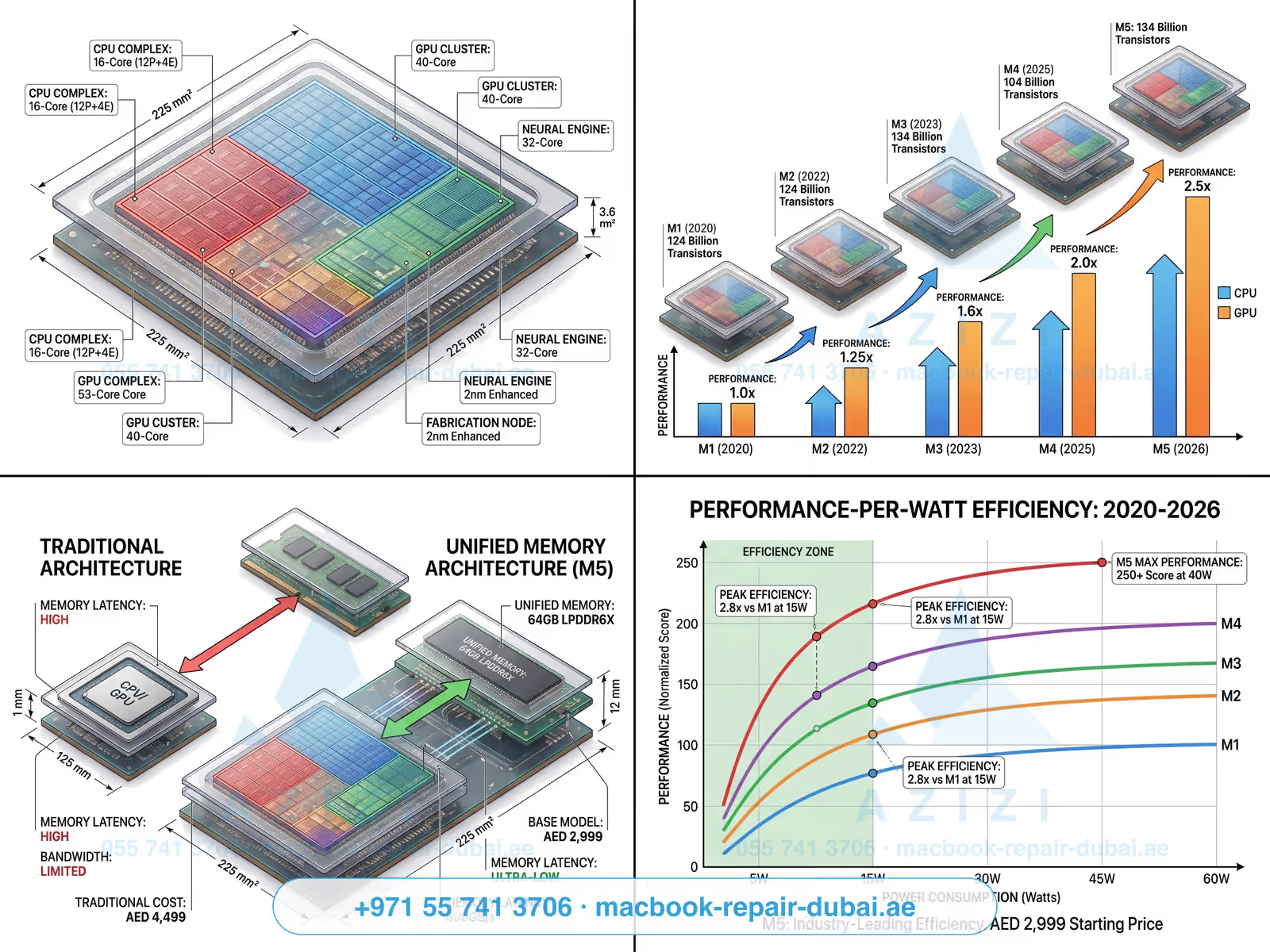
The M1 iMac (2021), M3 iMac (2023), and M4 iMac (2024) use Apple Silicon chips with a unified memory architecture. The CPU, GPU, Neural Engine, and RAM all share a single high-bandwidth memory pool on the same silicon package. Memory bandwidth on the M4 iMac is approximately 120 GB/s, versus around 40-50 GB/s for the DDR4 RAM in 2019 Intel iMacs. This architectural difference means the M-series machines can handle the same workloads with less physical RAM because memory access is significantly faster.
M-series iMacs also do not have the thermal paste problem because the chip is a single package with no separate CPU-heatsink interface requiring compound. The entire chip sits on a heat spreader with a factory-set thermal interface material that does not degrade in the same way. Power consumption is also dramatically lower: the M4 iMac draws about 30W under typical load versus 100-160W for an Intel i7 iMac, which means less heat generated in the first place.
For practical purposes: if you have an Intel iMac that is slow, the fixes in this guide will meaningfully improve it. If you have an M-series iMac that is slow, the most likely causes are SSD capacity, software, or (less commonly) RAM pressure from very large datasets. The M-series hardware itself rarely needs servicing for performance reasons until it is several years old.
iMac performance upgrade cost Dubai
All services below are handled at our Media City workshop. Parts are genuine or premium-grade compatible. No diagnostic fee for any booking. Turnaround is same-day for most services when booked before noon. Message us on WhatsApp for today's exact price on your iMac model.
| Repair / Service | Our price | Apple / third-party |
|---|---|---|
| SSD upgrade (Intel iMac) | Price on request | Price on request |
| RAM upgrade (Intel 21.5") | Price on request | Price on request |
| Thermal paste replacement | Price on request | Price on request |
| macOS reinstall + migration | Price on request | Price on request |
| Full performance service | Price on request | Price on request |
The full performance service combines SSD or RAM upgrade, thermal paste replacement, macOS clean install, and data migration in a single visit. It is the most cost-effective option if your iMac has been slow for a while and has multiple contributing factors, and it is significantly cheaper than buying a new machine if your Intel iMac is otherwise in good condition.
All upgrades include a 3-month written warranty on parts and labour. We carry common Intel iMac SSD and RAM configurations in stock, so most upgrades do not require ordering parts. Call or WhatsApp us with your iMac model (found under Apple menu > About This Mac) and we will confirm part availability before your visit.
When is slow iMac caused by a hardware fault?
If you have worked through all the software fixes and the performance upgrades above and the iMac is still slow, a deeper hardware fault may be present. The three most common hardware faults that cause performance problems beyond normal wear are: SSD NAND degradation (the flash cells physically losing their ability to hold charge reliably), logic board power delivery issues causing CPU voltage instability, and failing GPU causing the system to fall back to software rendering.
SSD health can be checked with a tool called DriveDx (available from the Mac App Store) or by reading the SMART data in Disk Utility. Look for reallocated sectors, uncorrectable errors, or a health rating below 80%. A degraded SSD will show high read/write latency even at low fill percentages, which software cleanup cannot fix. Replacement is the only solution.
Logic board power delivery faults typically show up as inconsistent performance: sometimes the Mac runs fine, other times it is extremely slow, and the behaviour does not correlate cleanly with load or temperature. This is a board-level repair that requires microsolder work. GPU faults often produce visual artefacts alongside the slowness: coloured lines, corrupted rendering, or a grey screen at boot. Both require a workshop diagnosis. Bring your iMac in for a free 20-minute diagnostic and we will identify the exact cause with Apple Service Toolkit 2 before quoting any repair.
Frequently asked questions
- When an iMac sleeps, macOS may write compressed RAM contents to the SSD (hibernate mode). On a full or slow SSD, resuming from sleep requires reading several gigabytes back from disk before the system is responsive. This appears as a 30-90 second delay after waking. Fix: free up SSD space to at least 15% capacity, and check Activity Monitor for memory pressure after waking.
- Not permanently from ambient temperature alone, but sustained high temperatures accelerate NAND flash wear on SSDs. Intel iMac SSDs running hot due to poor airflow (dust-clogged vents) or a nearby heat source age faster. The primary risk is thermal throttling that makes the machine unusable, not immediate hardware failure. Keeping the iMac's vents clear and in a 20-25°C room maximises longevity.
- Apple rates iMac SSDs for 150-300 TB written (TBW) depending on capacity. At typical home or office use (20-40 GB written per day), that translates to 10-20 years of rated write endurance. Real-world failures we see are mostly from heavy swap usage on undersized systems, which accelerates writes significantly. A 256 GB iMac running heavy swap may exhaust its write endurance in 5-7 years.
- A RAM upgrade fixes slowness caused by memory pressure and swap. To confirm this is your issue, open Activity Monitor > Memory and check the Memory Pressure graph. If it is yellow or red during normal use, and Swap Used is above 2 GB, a RAM upgrade will produce an immediate and significant improvement. If Memory Pressure is green and the SSD is near-full, a RAM upgrade will not help.
- SSD upgrades, RAM upgrades, and thermal paste replacements are all same-day services when booked before noon and parts are in stock. A full performance service (all three plus macOS reinstall and data migration) takes 4-6 hours. We will give you a specific pickup time when you drop off. Most customers leave the iMac in the morning and collect in the late afternoon.
- Heavy swap usage accelerates SSD wear but will not cause immediate data loss. Thermal throttling on Intel models is a protective mechanism, not a sign of imminent failure. However, running an SSD at over 95% capacity does increase the risk of filesystem errors and data loss if the last few gigabytes fill up during a write operation. Back up to Time Machine before any service, and address the root cause sooner rather than later.
Related on MacBook Repair Dubai
About the author
Memona is a senior apple device technician at MacBook Repair Dubai, Dubai's longest-running Apple-only repair workshop (since 2004). Personally signs the QC checklist on every job leaving the bench.