


Mac Pro GPU Repair and Upgrade Dubai: MPX Modules Explained
Graphics crashes, artifacts, or a dead display on a 2019 Mac Pro usually trace to an MPX GPU module fault, and our Dubai workshop diagnoses and repairs or upgrades MPX modules with free diagnosis.
Why does this happen?
The 2019 Mac Pro is the only modern Mac with a truly modular graphics system. Instead of a soldered GPU, Apple uses MPX modules: large cards that combine an AMD Radeon Pro GPU with the internal Thunderbolt 3 routing that feeds the front and rear ports. Each module seats into a dedicated MPX bay that carries PCIe lanes plus an auxiliary power and Thunderbolt connector, so a single seating fault can take out both the display and the ports. When a module degrades, you see graphics artifacts, app crashes under load, a black screen, or fans spinning to maximum the moment a 3D or video task starts.
On these cards the GPU silicon itself rarely fails first. The parts that wear out are the voltage regulation stage feeding the GPU, the small cooling fan bearings, and the high-density connector where the module mates with the MPX bay. Years of Dubai dust and heat stress those exact components. A module pulling 200 to 500 watts in a city where ambient air is already hot runs its VRMs near their thermal limit, and the solder around those regulators is the first thing to crack.
It matters which Mac Pro you own. The 2013 cylinder uses a fixed pair of soldered FirePro or D-series GPUs that cannot be swapped, only board-repaired. The 2010 to 2012 tower takes standard PCIe graphics cards, which are easy to swap. The 2019 tower is the MPX machine, and the 2023 Apple Silicon Mac Pro has no discrete GPU at all: the graphics are inside the M2 Ultra chip. Knowing your model tells you immediately whether this is a swap job, a board-level repair, or something that cannot be separated from the logic board.
Step 1: First checks you can do at home
Before assuming the GPU is dead, rule out the easy causes. A surprising share of Mac Pro graphics complaints come from a loose cable, a tired display, or a software state that a restart clears. Work through these in order, and note exactly when the fault appears, because that timing tells a technician a lot.
- Reseat the display cable: unplug and firmly reconnect the monitor at both the Mac Pro port and the display. On the 2019 model, try a rear Thunderbolt port and a front port separately, since the MPX module drives both routes.
- Try a second display: a known-good monitor and cable confirms whether the fault follows the Mac or the screen.
- Boot to Safe Mode: on the Intel Mac Pro, hold Shift at startup. Safe Mode loads a minimal graphics path. If artifacts vanish, the cause is likely software or a driver, not the module.
- Check Activity Monitor: open the GPU history window (Window menu, GPU History). A runaway process pinning the GPU can mimic a hardware fault and ramp the fans.
- Update macOS and AMD drivers: an interrupted update can leave the graphics stack in a bad state that looks like dying hardware.
If none of these help and the artifacts or crashes return in normal use, the problem is very likely the module, its bay, or the board feeding it. At that point stop stress testing the machine, because a failing GPU that crashes repeatedly can corrupt work and occasionally damage the power delivery further.
Step 2: Narrow down the cause
The goal here is to separate three very different problems: a tired module, a dirty or damaged MPX bay, or a logic board power fault. Each has a different cost and a different fix, so narrowing it down before any work starts saves you money. The pattern of the symptom is the biggest clue.
- Artifacts only under load: colored speckles, tearing, or geometry breaking up when you open Final Cut, DaVinci Resolve, or a 3D app points to GPU silicon or VRM stress on the module itself.
- Black screen at boot but the Mac is alive: the chassis fan spins and the power light is on, yet no image. This often means the module is not seating, the bay connector is dirty, or one GPU on a dual module has dropped out.
- Both ports and display dead together: because the MPX module also carries Thunderbolt, losing the GPU and the ports at the same time strongly suggests the module connector or the bay, not the monitor.
- Fan immediately at maximum: a module that cannot read its own thermal sensor defaults to full fan as a safety state. That is a module fault, not overheating.
- Crash logs naming the GPU: a kernel panic that references AMDRadeon or the graphics driver confirms the graphics subsystem rather than RAM or storage.
If you have a second compatible MPX module or a spare PCIe card, swapping it in is the fastest way to prove the point. When a known-good GPU works perfectly in the same bay, the original module is the fault. When the same fault follows into a different bay, you are looking at the board.
Step 3: How to confirm the fault
Confirmation is about evidence, not guessing. On the bench we use Apple Diagnostics, real graphics load, and direct electrical measurement to be certain which part is bad before quoting. You can start the first two steps yourself.
- Run Apple Diagnostics: shut down, then power on and immediately hold D on the Intel Mac Pro. A reference code in the PPT or VFD family points at power or video hardware and gives a clean starting point.
- Stress the GPU briefly: a short Heaven or GFXBench run that reproduces artifacts within a minute or two confirms the module fails under real load. Stop as soon as the fault appears.
- Measure module power rails: on the bench we probe the VRM output that feeds the GPU. A rail that sags or oscillates under load identifies a failing regulator rather than dead silicon, which is often repairable.
- Inspect the connector and bay: under magnification we check the MPX pins and the bay for bent contacts, oxidation, or dust packed into the connector, all common in Dubai air.
- Cross-test in a second bay: moving the module to the other MPX bay proves whether the fault is the module or the slot it was in.
By the end of this step the answer is usually clear: reseat and clean, board-level repair of the module, or replace the module. We share the diagnostic finding before doing any paid work, so you decide with the facts in front of you.
Step 4: What needs a technician
Reseating a module and cleaning a connector are within reach of a careful owner. Anything beyond that on a Mac Pro GPU needs a bench, the right tools, and component-level skill. The MPX module carries hundreds of watts and a dense Thunderbolt routing layer, so the risk of making a fixable fault permanent is real if it is opened without the proper setup.
- VRM and capacitor repair: replacing failed voltage regulators or leaking capacitors on the module needs hot-air rework, the correct components, and post-repair load testing.
- Connector and bay repair: a damaged MPX connector or a bay with bent or burnt pins is microsoldering work, not a home task.
- Fan and thermal service: re-pasting the GPU and replacing worn module fans must be done without disturbing the shielding and sensor wiring that the module relies on.
- GPU upgrade fitting: moving from a Radeon Pro 580X or W5700X up to a W6800X or W6900X module needs firmware-aware fitting and validation so macOS recognizes the new card cleanly.
- Board-level power faults: if the MPX bay itself, or the logic board power stage that feeds it, is the problem, that is a board repair, not a module swap.
We are independent Apple specialists, not an Apple Authorised Service Centre, which means we repair MPX modules at component level where Apple would only swap the whole card or the logic board. That is the difference between a targeted board-level repair and a far pricier whole-assembly swap. See our Mac Pro GPU repair service for current parts and turnaround.
Does Dubai heat make this worse?
Yes, and on a Mac Pro GPU the effect is direct. MPX modules dissipate a lot of heat, and in Dubai the air going into the chassis is already warm. When ambient temperatures climb above 35 degrees Celsius, often well above that in a poorly cooled office or a room near a glass facade, the module's VRMs and GPU run far closer to their limit than they would in a climate-controlled studio. Sustained heat is what cracks solder joints around the voltage regulators and ages the small module fans faster.
Dust makes the heat problem worse. Fine Dubai dust packs into the GPU heatsink fins and the MPX connector, choking airflow and trapping heat exactly where the module is most sensitive. A Mac Pro that ran cool for two years can start throttling and artifacting simply because its cooling path is clogged, which is why a thermal service often restores stability without any module replacement at all.
- Keep the room cool: aim to keep the Mac Pro in air below 25 degrees Celsius, well clear of summer ambient highs above 35 degrees Celsius.
- Give it breathing room: do not box the tower into a closed cabinet where hot exhaust recirculates.
- Schedule a clean: an annual dust-out of the heatsinks and MPX bay in a dusty Dubai environment is cheap insurance against premature module failure.
What is different between Intel and Apple Silicon repairs?
The single most important fact for a Mac Pro GPU problem is which generation you have, because the repair path is completely different. The 2019 Intel Mac Pro is the modular machine: MPX modules slot in and out, can be reseated, repaired, or upgraded, and a dead GPU does not mean a dead Mac. This is the model most of this guide is about, and it is the one with the most realistic fix options.
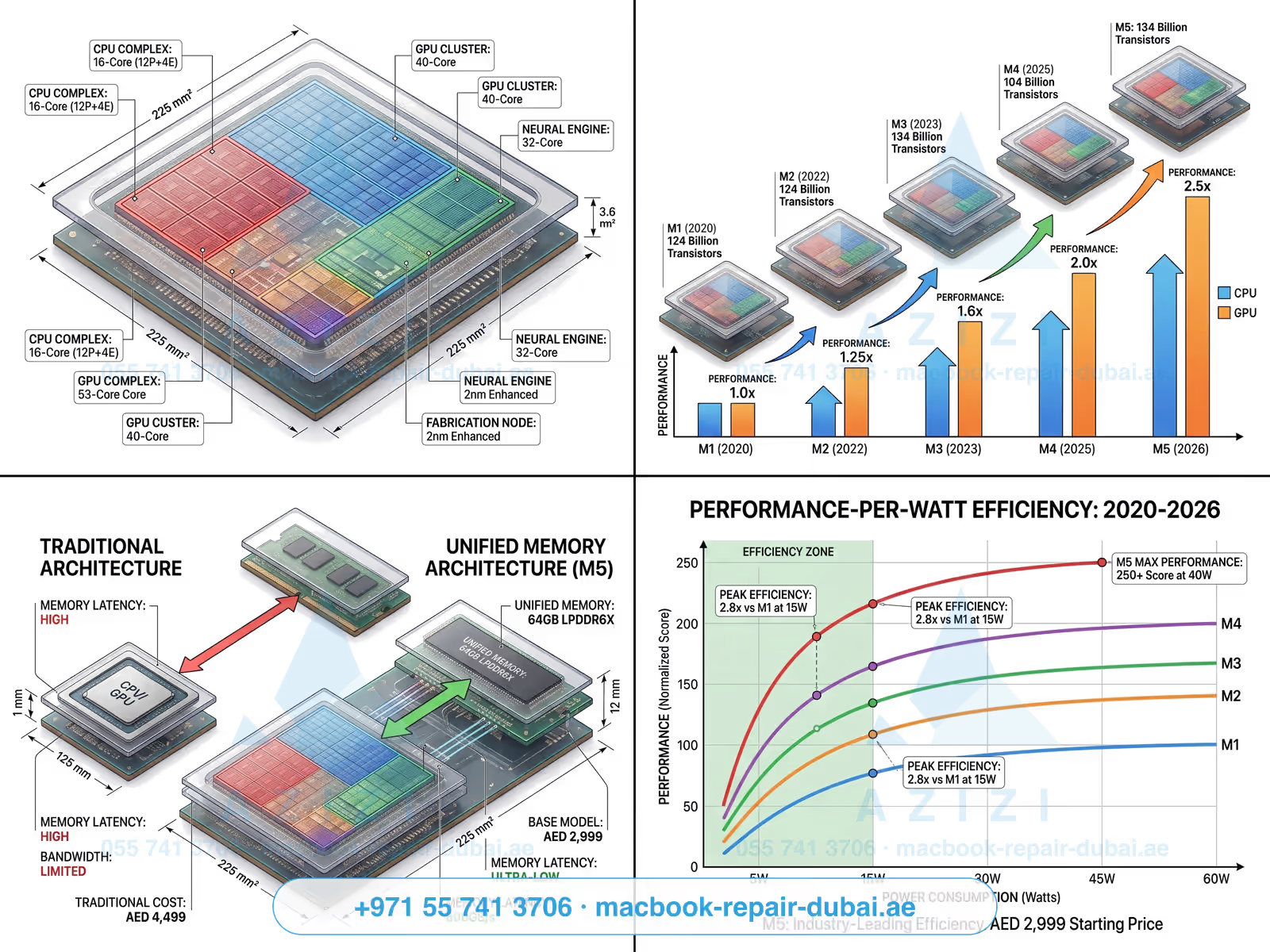
The 2023 Apple Silicon Mac Pro is a different animal. Its graphics are part of the M2 Ultra system on a chip, sharing unified memory with the CPU and Neural Engine. There are no MPX slots and nothing to swap: a true GPU hardware fault means a logic board repair or replacement, not a module change. The PCIe slots it does have are for capture, audio, and networking cards, not graphics. If you are on this model, the honest first step is to confirm whether the issue is software, a display, or genuinely the SoC, because the cost ladder is very different.
- 2010 to 2012 tower: standard PCIe graphics card, the easiest GPU to replace, parts widely available.
- 2013 cylinder: dual soldered AMD GPUs, no swap possible, board-level repair only.
- 2019 tower: MPX modules, fully serviceable, reseat, repair, or upgrade.
- 2023 Apple Silicon: integrated M2 Ultra GPU, no discrete card, board repair if the SoC graphics fail.
Mac Pro GPU repair Dubai repair cost in Dubai
Pricing depends on whether the module just needs reseating and cleaning, a board-level repair, or full replacement, and on whether you are repairing or stepping up to a faster module. Diagnosis is free, so you get an exact quote before any paid work begins. Use the quote form to send your Mac Pro model and symptoms for today's price on your repair.
| Service | Our price | Apple / third-party |
|---|---|---|
| GPU module reseat + diagnostic | Price on request | Higher |
| MPX module repair (board-level) | Price on request | Higher |
| GPU upgrade fitting | Price on request | Higher |
| Diagnosis | Free | Charged |
| Thermal service | Price on request | Higher |
Replacement modules themselves are quoted separately because used MPX prices move with the market, but the fitting and validation cost is what you see above. For a Radeon Pro 580X owner who wants more headroom, an upgrade to a W6800X module is usually the best value: a modern GPU at a known fitting cost, with the old module often resellable. We confirm the module is genuine and macOS-recognized before you collect.
When is it a deeper board fault?
Most Mac Pro graphics problems end at the module, but a minority point to the logic board or its power delivery. The tell is when a known-good module fails the same way, or when the MPX bay shows physical damage. In those cases swapping modules forever will not help, and the real fix is on the board.
- Fault follows into both bays: if a healthy module artifacts in either MPX bay, the board power stage feeding the bays is suspect.
- Burnt or bent bay pins: physical damage in the MPX connector on the board side needs microsoldering, not a module replacement.
- No power to the module rail: if the board is not delivering the auxiliary power the module needs, the GPU never starts, regardless of which card you fit.
- Thunderbolt dead with a working GPU: ports failing while graphics work can mean the board-side routing, not the module.
Board-level Mac Pro work is detailed, slower, and quoted after a full diagnosis, but it is still far cheaper than an Apple board swap. If your fault sits here, we will say so plainly and explain the options. Start with the free diagnosis on our Mac Pro repair Dubai page, and we will tell you exactly which layer the problem lives on.
Frequently asked questions
- On a 2019 Mac Pro, graphics artifacts and crashes under load usually trace to the MPX module: a stressed voltage regulation stage, a worn module fan, or a dirty bay connector. The GPU silicon itself fails far less often. Rule out the cable, display, and software first, then a free diagnosis confirms whether the module, the bay, or the board is at fault.
- Yes. MPX modules run hot, and when ambient air rises above 35 degrees Celsius the GPU and its voltage regulators sit close to their thermal limit. Sustained heat cracks solder around the regulators and ages the module fans. Fine Dubai dust packed into the heatsink and connector traps heat further, so an annual clean and a cool room meaningfully extend module life.
- A correct board-level repair of the voltage regulation or connector restores the module to normal service life, typically years if the cooling path is kept clean. A replacement or upgraded module performs like new. The biggest factor in how long it lasts is heat: a module kept in cool, dust-free air well below the 35 degrees Celsius summer ambient outlasts one in a hot, dusty room.
- If diagnosis points to the MPX module, then reseating, a board-level repair, or a replacement module resolves the artifacts, crashes, or black screen and the Mac runs normally again. If the fault is in the MPX bay or the logic board power stage, a module swap alone will not fix it, which is why we confirm the failing layer before any paid work so the repair you pay for is the one that solves it.
- A reseat, clean, and diagnostic is often same-day. A board-level MPX module repair typically takes two to four working days depending on parts and load testing. An upgrade or replacement module is fitted and validated within a day or two once the module is on hand. We give a timeline with the free diagnosis result so you know before committing.
- Light use is usually fine, but stop running heavy graphics tasks once you see repeated artifacts or crashes. A GPU that crashes under load can corrupt unsaved work and, in rare cases, stress the power delivery further. If the fan pins to maximum at idle or the module gives a black screen at boot, bring it in for diagnosis rather than forcing it to run.
Related on MacBook Repair Dubai
About the author
Memona is a senior apple device technician at MacBook Repair Dubai, Dubai's longest-running Apple-only repair workshop (since 2004). Personally signs the QC checklist on every job leaving the bench.