
MacBook Pro M4 16GB Memory Pressure in Dubai? Here is Why and What to Do
MacBook Pro M4 with 16GB shows memory pressure warnings more often than M3 with the same RAM because M4 Pro and M4 Max are configured with larger GPU core counts, and the GPU shares the same 16GB pool. Understanding the memory pressure graph, green, yellow, red, tells you if 16GB is the actual problem or if an app is misbehaving.
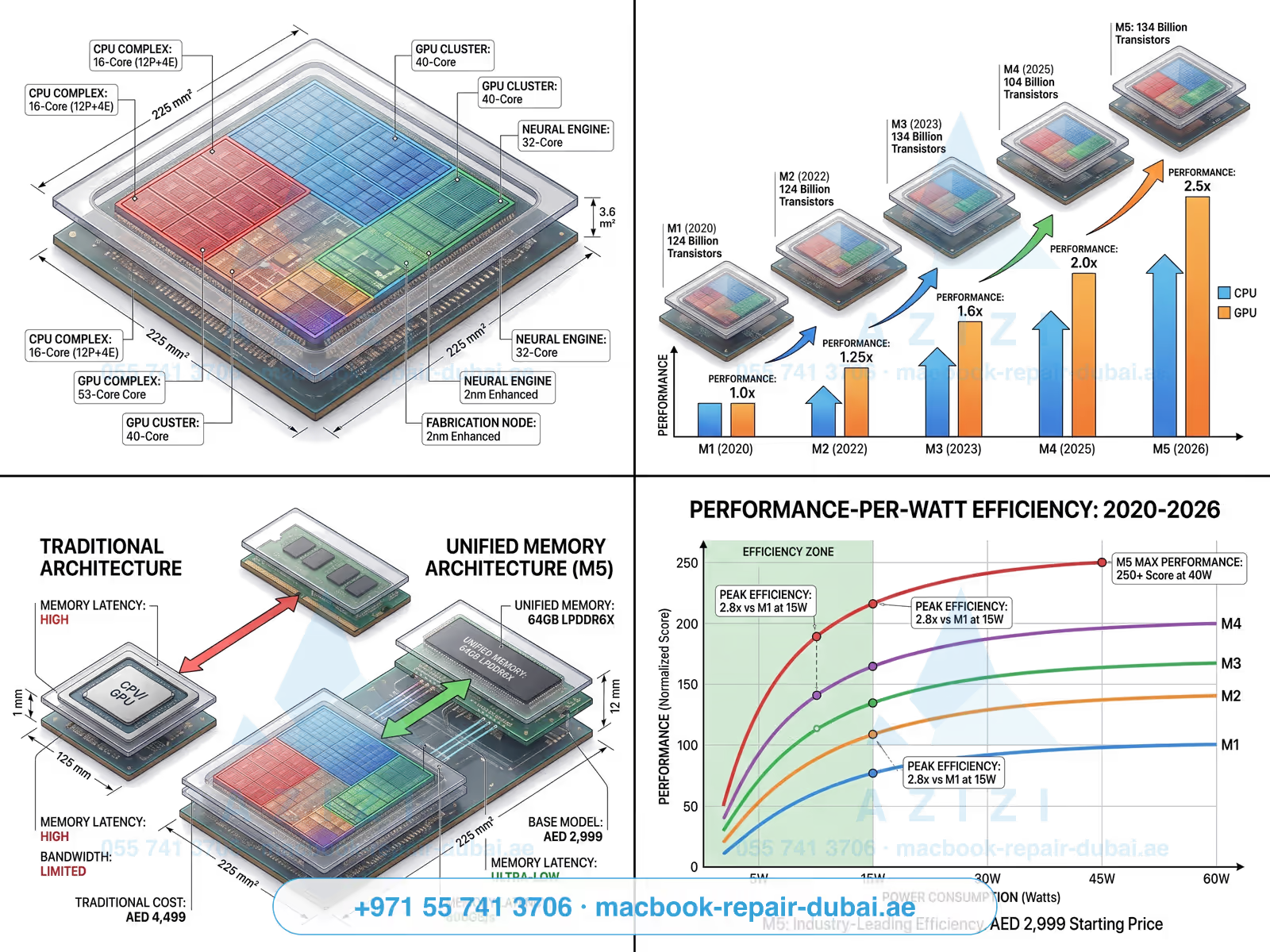
Why does MacBook Pro M4 16GB show memory pressure?
The M4 chip uses unified memory architecture: the CPU, GPU, and Neural Engine all share the same physical memory pool. On M4 Pro and M4 Max with 16GB, the GPU has more cores than M3 baseline, and macOS reserves more memory for the GPU. This leaves less available for applications compared to a 16GB M3 with fewer GPU cores.
- M4 Pro 14-inch with 16GB: GPU has 20 cores. macOS reserves ~2-3GB for the GPU, leaving 13-14GB for apps
- M4 baseline 14-inch with 16GB: GPU has 10 cores. Less GPU reservation, more headroom for apps
- M4 Max with 36GB: not affected: 36GB provides ample headroom even with the 40-core GPU
Memory pressure is also influenced by macOS memory compression. macOS compresses inactive memory pages to free RAM without writing to the SSD. When compressed memory also runs out, it starts swapping to the SSD, which significantly slows the system.
Step 1: How do I read MacBook Pro M4 memory pressure graph?
- Open Activity Monitor (Spotlight: Activity Monitor), click Memory tab
- Bottom of the window shows the Memory Pressure graph and Memory Used, Swap Used values
- Green pressure: memory is available. Apps are running without compression or swap
- Yellow pressure: memory is being compressed. Performance is still acceptable but the M4 is managing memory actively
- Red pressure: memory is exhausted and swap is active. The SSD is being used as overflow RAM. Performance degrades noticeably: UI lag, app launches slow, beach ball cursors
Check "Swap Used" (bottom of Memory tab). If swap used is above 1GB during your typical workflow, and this happens regularly, 16GB is not enough for your use case.
Step 2: Which apps are using the most MacBook Pro M4 memory?
- In Activity Monitor, Memory tab, sort by "Memory" column descending
- Note the top 5 processes by RAM usage
| App / Process | Typical RAM | Notes |
|---|---|---|
| Google Chrome (10+ tabs) | 4-8GB | Each tab is a separate process. Use Safari to reduce browser RAM by 40-60% |
| Final Cut Pro / DaVinci Resolve | 6-16GB | Video editing is the primary legitimate 16GB bottleneck case |
| Xcode + Simulator | 4-8GB | Running iOS/macOS simulators requires substantial RAM |
| Microsoft Teams + Outlook | 1.5-3GB combined | Electron apps are RAM-heavy. Quit Teams when not in calls |
| Photoshop + Illustrator + Lightroom | 4-8GB | Running all three simultaneously stresses 16GB on M4 Pro |
Step 3: How does MacBook Pro M4 swap affect SSD health?
When macOS runs out of RAM and swap, it writes compressed memory pages to the internal SSD. The M4 SSD is rated for a certain number of total bytes written (TBW) before NAND flash wear accumulates. Heavy swap use accelerates this wear.
- To check SSD health: install smartmontools via Homebrew, then run
sudo smartctl -a /dev/disk0. Look for "Data Units Written" - For reference: Apple's M4 14-inch SSD is typically rated for 800TB-1PB TBW. Normal home/office use consumes 20-40GB/day. Heavy swap from chronic 16GB pressure can push this to 500GB/day, reducing SSD lifespan from years to months
- If swap regularly exceeds 5GB per session, SSD wear is a concern and upgrading RAM is the correct solution, not just a performance preference
Step 4: What macOS settings reduce MacBook Pro M4 memory pressure?
- Close unused tabs in Chrome: the single highest-impact action. Shift to Safari for lower-priority browsing. Chrome tabs each hold their own process in memory, Safari tabs share resources
- Quit apps, do not just minimise: minimised apps still hold their RAM allocation. Cmd+Q to quit apps you are not using
- Disable unused browser extensions: extensions run as persistent background processes consuming RAM
- Restart weekly: macOS accumulates memory fragmentation over days of uptime. A weekly restart recovers several GB of effective RAM on a heavily-used machine
- Reduce virtual desktops: each Mission Control space keeps its windows' GPU surfaces in memory. Fewer spaces = less persistent GPU memory use
Does Dubai heat affect MacBook Pro M4 memory performance?
- Unified memory (LPDDR5X in M4) is more thermally sensitive than the separate RAM chips in Intel Macs. At sustained high temperatures, memory bandwidth can be reduced as a thermal protection measure
- In Dubai summer, if the M4 is in a room without adequate AC and the chip runs hot, available memory bandwidth decreases, which can make memory pressure symptoms worse than normal
- A properly cooled M4 (ambient under 25°C) will maintain full memory bandwidth. Check iStat Menus or similar to monitor chip temperature if you suspect thermal throttling is compounding memory pressure issues
MacBook Pro M4 16GB vs 24GB: who actually needs more RAM?
| Use case | 16GB sufficient? | Why |
|---|---|---|
| Office work, email, web browsing (Safari) | Yes | Typical peak usage 8-10GB, well within 16GB even with GPU share |
| Software development (Xcode, VSCode, Terminal) | Usually yes | Pressure appears only when running 2+ simulators simultaneously |
| Heavy Chrome multitasking (20+ tabs) or multiple Electron apps | No | Chrome alone can use 8-12GB with many tabs. Combined with other apps, 16GB runs out |
| Video editing (Final Cut Pro, DaVinci, Premiere) | No for 4K+ | 4K editing with effects needs 24-36GB. 16GB causes frequent proxy rendering |
| ML/AI model inference (local LLMs) | No for 7B+ models | Running a 7B parameter model at full precision requires ~14GB RAM alone |
MacBook Pro M4 memory cannot be upgraded: your options in Dubai
M4 memory is soldered directly to the SoC die. There is no RAM slot, no upgrade path, and no third-party service that can add RAM to an M4 without replacing the entire logic board. Options if 16GB is genuinely too little:
| Option | Cost | Notes |
|---|---|---|
| Trade up to M4 Pro 24GB | Price on request | Buying new in UAE or used on OLX/Dubizzle is the best value upgrade path, message us for guidance |
| Trade up to M4 Max 36GB | Price on request | M4 Max handles professional video, ML, and heavy multitasking |
| External RAM workaround (none) | Not possible | There is no way to add external RAM to an M4 MacBook Pro |
| Logic board replacement with higher-RAM board | Price on request | Only viable if the original board has another fault, not a cost-effective RAM upgrade |
When is MacBook Pro M4 16GB genuinely not enough in Dubai?
- Swap used exceeds 2GB during your regular daily workflow (not a one-off task)
- Memory pressure graph is red more than yellow across a normal working day
- M4 fan spins continuously even when tasks appear light (swap + heat)
- App latency and beach-ball cursors appear frequently with fewer than 10 browser tabs open
Frequently asked questions
- For most Dubai office work, email, web browsing in Safari, Microsoft Office, video calls, 16GB is sufficient. Memory pressure appears under heavy Chrome multitasking (20+ tabs), Electron apps like Teams and Slack open simultaneously, or creative work in multiple Adobe apps. If your work involves only one of these, 16GB is fine. If you do all of them at once, 24GB is the correct configuration.
- No. M4 memory is soldered directly to the chip die and cannot be upgraded after purchase by any repair shop or service provider. The only way to get more RAM is to trade up to a higher-specification M4 model. This is why choosing the right RAM configuration at purchase is critical.
- The M4 Pro GPU has more cores than M3 Pro, and the GPU shares the unified memory pool. On the same 16GB, M4 Pro reserves more for GPU use, leaving slightly less for applications than an M3 Pro. The net result is that M4 Pro can feel tighter on memory for RAM-heavy app workflows, even though the overall chip is faster.
- Under normal use, swap is occasional and the impact on SSD lifespan is negligible. If swap regularly exceeds 2-5GB per session (meaning 16GB is chronically insufficient), SSD write amplification can reduce the SSD's effective lifespan from years to months at the extreme end. Monitoring swap via Activity Monitor and reducing memory pressure protects the SSD.
- Memory pressure itself causes no damage. It is a normal macOS memory management state. The risk is to the SSD if memory compression fails and heavy swap usage accelerates NAND write cycles. The performance impact of high memory pressure (lag, slow app launches) is temporary and resolves when memory is freed.
- For most Dubai freelancers: M4 Pro 24GB covers photography, design, development, and video editing at 1080p-4K. M4 baseline 16GB is adequate for one creative discipline at a time. M4 Max 36GB is warranted for full-time video editors working in 4K ProRes, machine learning, or running multiple professional apps simultaneously at full capacity.
Related on MacBook Repair Dubai
About the author
Memona is a senior macbook battery technician at MacBook Repair Dubai, Dubai's longest-running Apple-only repair workshop (since 2004). Personally signs the QC checklist on every job leaving the bench.